
Closing the loop
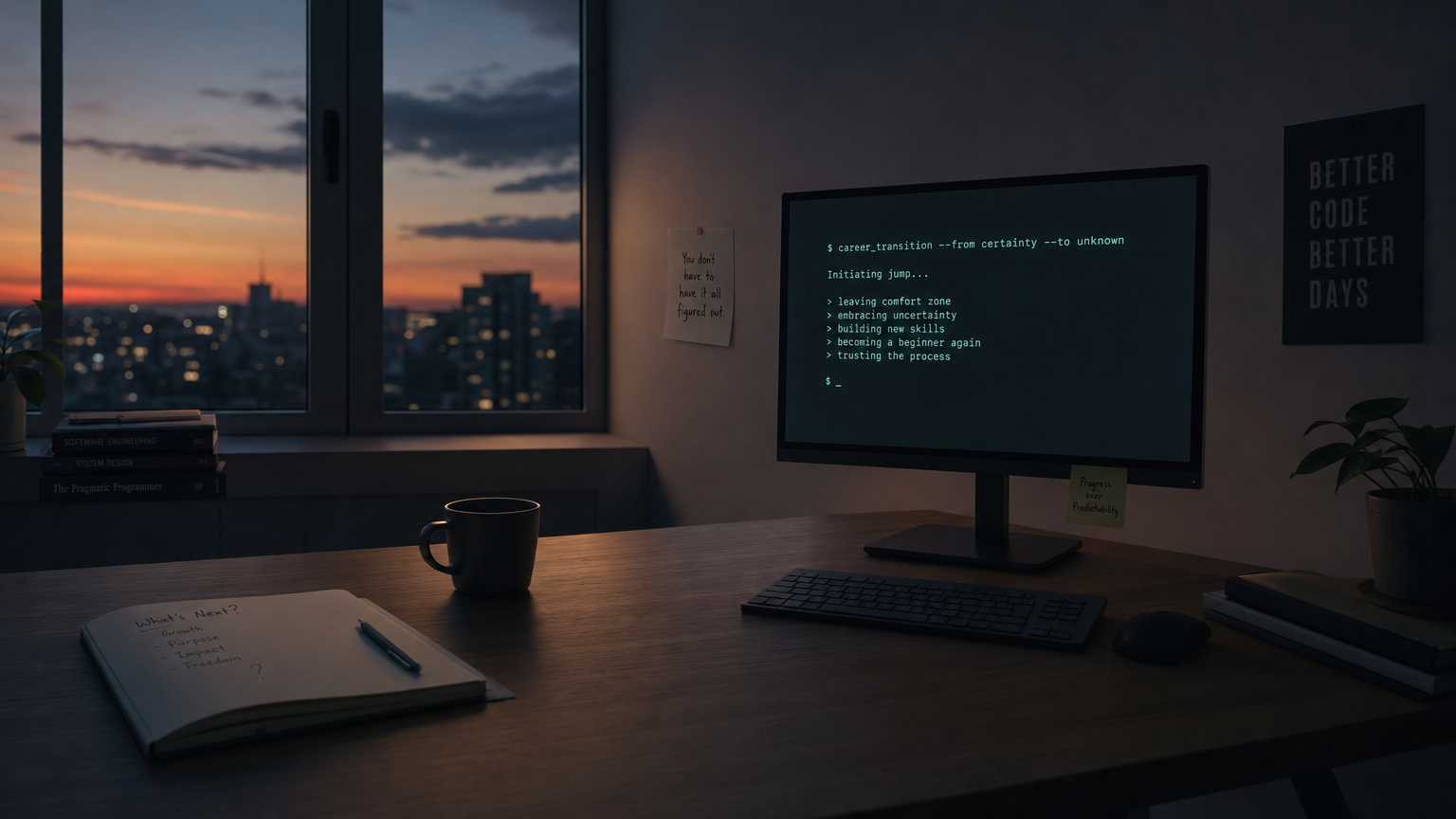
I’ve been sitting with a lot lately.
Which is probably obvious, because that is usually when I end up writing one of these. Not because I have some perfectly formed point I’m trying to make, or because I’ve reached the end of the thought and now I can package it up neatly for the internet.
More just because if I don’t get the thought out somewhere, it sits in my head and turns into a much worse version of itself.
So, yeah.
This is me trying to close the loop on the last few months.
I haven’t been working for a while now, and that has given me far too much time to think about what I want to do next, what I’m actually good at, what parts of my career I still want to carry forward, and what parts I maybe need to leave behind.
And I don’t have a clean answer.
That’s the annoying bit.
I would love to have one. I would love to be able to say “I’m going to pivot into this exact role, with this exact title, at this exact kind of company, and it all makes sense now”.
But I don’t think that’s where I am.
Where I am is more like this weird middle space where I know the old path doesn’t fit the same way it used to, but the new one hasn’t fully shown itself yet.
Which is deeply inconvenient, honestly.
The weird part about leaving something you were good at
I’ve worked in IT support / internal technology / corporate engineering / whatever we are calling “the people who keep things working behind the scenes” for more than a decade now.
And I was good at it.
I’m not saying that in a “please clap” way. I just was.
I understood the work. I understood users. I understood the weird gap between what a system technically does and what people actually need from it. I could sit with a messy operational problem, pull it apart, automate some of it, document the bits that needed documenting, and generally make the whole thing less painful.
That was always the part I liked most.
Not the password resets.
Not the MDM profile arguments.
Not the “can you just quickly” drive-by requests that are somehow never quick.
It was the systems stuff. The pattern matching. The “why are we doing this manually?” stuff. The bit where you can see that three teams are all doing slightly broken versions of the same process and nobody has had the time, energy, or permission to step back and go “hang on, this is silly”.
That’s the bit that still lights my brain up.
But the hard thing is, when the broader job starts to feel tangled up with burnout, stress, and a lot of not-great memories, it becomes harder to separate the work from the feeling of the work.
And that’s where I’ve been stuck.
Because I don’t think I stopped caring about technology.
I don’t think I stopped caring about users.
I don’t think I stopped caring about making work better.
I think I just hit a point where the shape of the job I was in, and maybe the shape of the path I thought I was on, stopped making sense for me.
People management was complicated
I also gave people management a go.
I wanted to be good at it. I really did.
I wanted to take all the things I’d learned from being on the tools for years and use that to help someone else build confidence and figure out where they wanted to go.
And I still think that’s a good instinct.
But the reality was more complicated than the idea of it.
People management is hard in ways that I don’t think people are always honest about. It’s not just assigning work and doing one-on-ones and saying encouraging manager things. It’s trying to understand someone’s motivation, confidence, uncertainty, career direction, communication style, and all the other stuff that sits underneath the actual work.
And when someone is still figuring out what they want, that becomes even harder.
Not bad. Not wrong. Just hard.
You want to give them opportunity, but you also need to know what kind of opportunity is actually useful. You want to support them, but you also need support yourself. You want to help them grow, but you’re also trying to work out how to grow into the role you’ve been given.
And I don’t think I had the structure around me that I needed to do that well.
That’s probably the most balanced way I can say it.
I tried. I asked questions. I tried to learn. I tried to find the right way through it.
But looking back, I think I was trying to learn a very people-heavy job while also already being stretched pretty thin myself.
That’s not a great combo.
I think I was looking in a different direction
The other thing I keep coming back to is that I was spending more and more of my energy looking at AI, automation, agentic workflows, internal tooling, documentation, and all the ways these things could make boring work less awful.
Which, yeah, is a very me sentence.
But it’s true.
I could see this shift happening and I wanted to be part of it. Not in the breathless “AI will fix everything” way, because no, it absolutely will not.
AI is not magic.
It is not a replacement for thinking.
It is not a corporate fairy wand you wave over broken process and suddenly everything is fine.
If your process is bad, AI can absolutely help you make a bad process faster, which is not always the win people think it is.
But used properly, with some actual thought behind it, it is a lever.
A really big one.
And I think that is the part I kept getting drawn toward. Not “chatbot everything”. Not “replace people”. Not “let’s cram AI into every workflow because someone on LinkedIn said agentic”.
More like, where are people wasting time? Where is knowledge trapped? Where are we making humans do boring translation work between systems? Where are we relying on memory when we could rely on structure? Where are people copying things from one place to another because nobody has had the time to build the bridge?
That’s the kind of work I want to do more of.
And I think, for a while, I was trying to pull my career in that direction before I really had the language for it.
Which made things weird.
Because if the role you are in needs one thing from you, but your brain has started seeing a completely different future, you end up in this awkward place where you are technically doing the job, but also kind of trying to evolve it at the same time.
Sometimes that works.
Sometimes it very much does not.
The ending was strange
Leaving was strange.
Not dramatic in the way movies make leaving seem dramatic.
Just strange.
There’s this odd thing that happens when you leave a workplace after years of it being part of your everyday life. One day it is meetings and messages and access and context and all the tiny little bits of invisible work that make up being part of a place.
Then it’s done.
You post a goodbye message.
People react with emojis.
A few people reach out.
Some people don’t.
And then the place keeps going, because of course it does.
That’s not a criticism. That’s just how work works.
But it is still a weird thing to sit with.
You can spend years somewhere and then the practical ending of it is very small. A message, a few reactions, maybe a couple of private notes, and then your account disappears from the systems.
I think I expected the ending to feel more complete.
It didn’t.
It just felt like a door closing quietly.
Maybe that’s better in the long run. I don’t know.
So what now?
This is the part I don’t have neatly worked out.
I don’t know if I want to go back into traditional IT support.
That’s a scary thing to admit, because it’s the obvious path. It’s the experience I have. It’s the thing that makes sense on paper.
Help desk. Desktop support. Internal IT. Systems support. Corporate engineering.
The ladder is there.
I just don’t know if I want to climb that exact ladder again.
Or maybe it’s not even that I don’t want to. Maybe it’s that I need to be more honest about which parts of the work I actually want to keep doing.
Because I don’t think I’m done with IT.
I don’t think I’m done with support either, really.
I think I’m done with support as the whole identity.
I don’t want my future to just be “person who reacts to broken things”.
I want to be closer to the work that prevents things from being broken in the first place. Or the work that makes the fix repeatable. Or the work that turns the messy recurring problem into a tool, a workflow, a document, an automation, or even just a clearer way of thinking.
That’s where I think I’m useful.
Somewhere between IT, operations, AI tooling, automation, documentation, systems thinking, and being the person who asks “why are we doing it this way?” slightly too often.
Which, admittedly, is not the cleanest job title.
Maybe this is just the awkward middle bit
I think part of what I’m feeling is grief.
Not just grief for a job, but grief for the version of my career I thought I understood.
There’s a weird kind of safety in thinking you know the path you’re on. Even if the work is hard, even if it’s messy, at least the shape of it makes sense.
Then something changes and suddenly the map doesn’t look like the territory anymore.
And now I’m here, trying to work out what parts of the last decade still come with me.
Because I don’t want to throw all of it away.
That would be silly.
I have skills. I have experience. I have a very particular ability to sit in the middle of technical mess, operational nonsense, user needs, broken process, and vibes, and somehow turn that into something useful.
That has value.
I know that.
I don’t always feel it right now, but I know it.
And I think that’s enough to start from.
Closing the loop, properly
I don’t know what comes next.
I wish I did.
It would be much more satisfying to end this with a neat little “and that’s why I’m launching a consultancy” paragraph or some big confident statement about the future.
Maybe that comes later.
For now, I think this is just me saying that a chapter ended and I’m trying not to let the ending define the whole story.
There was good in it.
There was hard in it.
There are things I learned that I’ll keep.
There are things I’ll leave behind.
And there are probably a lot of things I won’t fully understand until I’ve had more distance from it all.
But I still care about the work.
I still care about technology.
I still care about making people’s jobs less frustrating.
I still care about AI and automation and the way these tools are going to reshape a lot of boring operational work, whether companies are ready for that or not.
And I still think I can be useful in that future.
I just need to find the right shape for it.
So, yeah.
That’s where I’m at.
A little unsure. A little bruised. A little curious. Still thinking about workflows. Still probably too interested in Mac minis. Still trying to work out what the next version of work looks like.
But moving forward.
Slowly, maybe.
But forward.